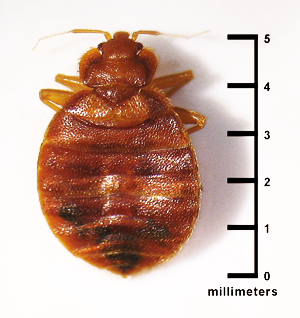
Description
The common bed bug (Cimex lectularius) has long been a pest – feeding on blood, causing itchy bites and generally irritating their human hosts. The Environmental Protection Agency (EPA), the Centers for Disease Control and Prevention (CDC), and the United States Department of Agriculture (USDA) all consider bed bugs a public health pest. However, unlike most public health pests, bed bugs are not known to transmit or spread disease.
How to Find Bed Bugs
If you have a bed bug infestation, it is best to find it early, before the infestation becomes established or spreads. Treating a minor infestation, while an inconvenience, is far less costly and easier than treating the same infestation after it becomes more widespread.
However, low-level infestations are also much more challenging to find and correctly identify. Other insects, such as carpet beetles, can be easily mistaken for bed bugs. If you misidentify a bed bug infestation, it gives the bugs more time to spread to other areas of the house or hitchhike a ride to someone else’s house to start a new infestation. Learn about identifying bed bugs.
Bites on the skin are a poor indicator of a bed bug infestation. Bed bug bites can look like bites from other insects (such as mosquitoes or chiggers), rashes (such as eczema or fungal infections), or even hives. Some people do not react to bed bug bites at all.
Where Bed Bugs Hide
Canvas strap of old box spring covering that is housing adults, skin castings, feces, and eggs. (Photo courtesy of Dr. Louis Sorkin)
When not feeding, bed bugs hide in a variety of places. Around the bed, they can be found near the piping, seams and tags of the mattress and box spring, and in cracks on the bed frame and headboard.
If the room is heavily infested, you may find bed bugs:
- In the seams of chairs and couches, between cushions, in the folds of curtains.
- In drawer joints.
- In electrical receptacles and appliances.
- Under loose wall paper and wall hangings.
- At the junction where the wall and the ceiling meet.
- Even in the head of a screw.
Since bed bugs are only about the width of a credit card, they can squeeze into really small hiding spots. If a crack will hold a credit card, it could hide a bed bug.
Bed Bug Behavior and Habit
Understanding the behavior of bed bugs (how they eat, live, and reproduce) will help you to find an infestation before it becomes established and to monitor for the presence of bed bugs after your home has been treated.
Feeding:
- Appear to prefer to feed on humans, but will feed on other mammals and birds as well.
- Will readily travel 5-20 feet from established hiding places (called harborage) to feed on a host.
- Even though they are primarily active at night, if hungry they will seek hosts in full daylight.
- Feeding can take 3-12 minutes.
- The rusty or tarry spots found on bed sheets or in bug hiding places are because 20% of the time adults and large nymphs will void remains of earlier blood meals while still feeding.
Life stages/mating:
- Bed bugs need at least one blood meal before the individual bug can develop to the next of the six life stages.
- They can feed more than once.
- Each stage also requires the molting of skin.
- To continue to mate and produce eggs, both males and females must feed at least once every 14 days.
- Each female may lay 1 to 3 eggs per day and 200-500 eggs per her lifetime (6-12 months but could be longer).
- Egg-to-egg life cycle may take four to five weeks under favorable conditions.
Living conditions:
- Bed bugs can survive and remain active at temperatures as low as 7°C (46°F), but they die when their body temperatures reaches 45°C (113°F).
- To kill bed bugs with heat, the room must be even hotter to ensure sustained heat reaches the bugs no matter where they are hiding.
- Common bed bugs are found almost anywhere their host can live.
- Tropical bed bugs (Cimex hemipterus) require a higher average temperature than the common bed bug and are found in tropical and subtropical areas.
Protecting Your Home from Bed Bugs
Bed bugs are great hitchhikers. They can move from an infested site to a new home by traveling on furniture, bedding, luggage, boxes, and clothing.
Although they typically feed on blood every five to ten days, bed bugs can be quite resilient; they are capable of surviving several months to a year without feeding.
A few simple precautions can help prevent bed bug infestation in your home:
- Check secondhand furniture, beds, and couches for any signs of bed bug infestation before bringing them home.
- Use a protective cover that encases mattresses and box springs to eliminate many hiding spots. The light color of the encasement makes bed bugs easier to see. Be sure to purchase a high quality encasement that will resist tearing and check the encasement regularly for holes or a cover that has been pre-treated with pesticide to control bed bugs.
- Reduce clutter in your home to reduce hiding places for bed bugs.
- Vacuum frequently to remove any successful hitchhikers.
- Be vigilant when using shared laundry facilities. Transport items to be washed in plastic bags (if you have an active infestation, use a new bag for the journey home). Remove from dryer directly into bag and fold at home. (A dryer on high heat can kill bed bugs.)
- If you live in a multi-family home, try to isolate your unit by:
- Installing door sweeps on the bottom of doors to discourage movement into hallways.
- Sealing cracks and crevices around baseboards, light sockets, etc., to discourage movement through wall voids.
- Consider purchasing a portable heating chamber to treat any items that you believe may have bed bugs.
- Be sure to read and carefully follow the directions if you use one of these units and be aware that they are not regulated by EPA or other federal agencies.
- More information on controlling bed bugs.
Controlling Bed Bugs Using Integrated Pest Management (IPM)
Related Information
The Federal Bed Bug Workgroup has completed a Collaborative Strategy on Bed Bugs.
The strategy highlights ways that all levels of government, community, academia and private industry can work together to reduce bed bugs across the United States. It outlines four priority areas for bed bug control:
- Prevention.
- Surveillance and Integrated Pest Management [IPM].
- Education and Communication.
- Research.
Información relacionada disponible en español
Controlling bed bugs takes time and patience. The biology of bed bugs dictates this, since they reproduce quickly and their eggs are resistant to many methods of pest control, both chemical and non-chemical. This page describes some of the techniques that have been found to be effective against bed bugs.
Understanding IPM
Integrated pest management is an effective and environmentally sensitive approach to pest management. IPM programs use information on the life cycles of pests and their interaction with people and the environment. This information, combined with available pest control methods, is used to manage pest damage by the most economical means, and with the least possible hazard to people, property, and the environment.
IPM takes advantage of all appropriate pest management options, including the judicious use of pesticides. Although bed bugs may sometimes be controlled by non-chemical means alone, this approach is often very difficult, potentially less effective, and usually more resource intensive.
Bed bug control is most effective when an IPM approach is implemented with diligent participation by the residents. In multi-family housing, diligent participation is also required of the building management.
A comprehensive IPM program to control bed bugs may include a number of non-chemical and chemical methods. Some of these are described in the following sections.
Non-Chemical Methods
- Put bedding and clothing in the dryer at high temperatures for 30 minutes to kill bed bugs (just washing will generally not kill bed bugs).
- Heat infested articles (e.g., furniture, luggage, other items that can’t go in a clothes dryer) and/or areas (i.e., a room in a house or apartment, or a whole house) to at least 120 ºF (approx. 49 ºC) for 90 minutes to ensure that eggs are killed.
- The higher the temperature, the shorter the time needed to kill bed bugs at all life stages.
- This is often done using a heat-generating device or in a specially constructed heating unit, some of which are portable.
- Cold treatments (below 0 ºF (-19 ºC) for at least 4 days) can eliminate some infestations.
- The cooler the temperature, the less time needed to kill bed bugs.
- Home freezers may not cold be enough to reliably kill bed bugs. Always use a thermometer to measure the temperature.
- Read more at Using Freezing Conditions to Kill Bed Bugs Exit
- Use mattress, box spring, and pillow encasements to trap bed bugs and help detect infestations.
- Use monitoring devices such as bed bug interceptors to ensure that the bed bugs have been truly eradicated.
- See the “do-it-yourself” steps for more details on methods to reduce and control bed bug populations.
Using Pesticides
- Use a comprehensive strategy for controlling bed bugs – pesticides should be only one part of a multi-part IPM plan.
- Use the Bed Bug Product Search tool to help you find a pesticide product that meets your needs. Currently, there are over 300 products registered by EPA for use against bed bugs — the vast majority of which can be used by consumers.
- Before reapplying or trying a different product read, When Treatments Don’t Work.
- You may want to consult a pest management professional to inspect your residence and, if needed, apply approved pesticides to treat any infestation.
- For assistance with choosing a pesticide registered for consumer use, you may also check with the Cooperative Extension Service office in your area.